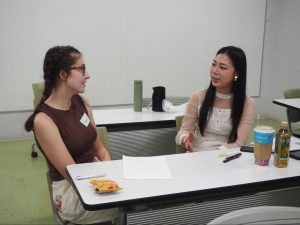

| Facilitator | HUANG XIAOYUN (ToTAL Student) |
| Date & Time | Friday, December 12, 2025, 18:00 – 20:30 |
| Venue | Room S6-305, South Building 6, Ookayama Campus |
| Book | Surrounded by idiots(Thomas Erikson) |
Objectives
・To practice summarizing and sharing complex themes in a short timeframe.
・To gain experience in accepting others’ perspectives and deepening dialogue.
・To improve language proficiency and expressive skills.
Overview
In this workshop, we will conduct a study group to explore books that (1) aid in leadership development and (2) enhance insight into future society. We will utilize a unique reading method called “Active Book Dialogue” to facilitate concentrated reading and discussion among participants within a limited time.
Why we chose this book
The facilitator selected Surrounded by Idiots because it offers a clear and practical framework for understanding different communication styles. Since effective communication is essential in both academic teamwork and future workplace environments, she wanted to learn how to adapt my approach depending on the personality types I interact with.
Activity 1: Read Book(Co-summarize)
Each participant read 10 to 15 pages and summarized them on six sheets of B5 paper. Although the book was written in English—making it easier for native speakers—I found the language relatively simple and easy to follow. It included personal experience from the author, which made it an enjoyable read. Some participants even prepared scripts for their two-minute presentations.
Activity 2: Presentation (Relay-presentation)
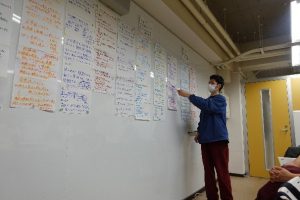
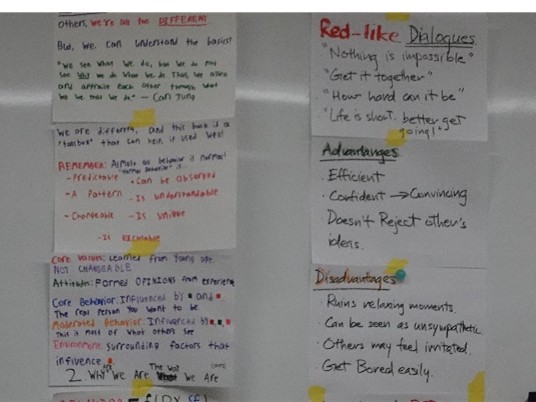
Each person gave a two-minute presentation using six paper slides. Many participants added their own drawings, showcasing their unique presentation styles. For most, two minutes wasn’t quite enough time, which made it a great exercise in learning how to summarize points concisely. Although I didn’t read the book myself this time, I understood the core message: that our behavior is shaped by our innate personalities and environments. The author categorizes communication styles into four color-coded patterns: red, blue, yellow, and green. I learned the distinct characteristics, as well as the strengths and weaknesses of each. Some of the presentations were incredibly humorous and had everyone laughing.

Activity 3: Discussion, sharing own episodes
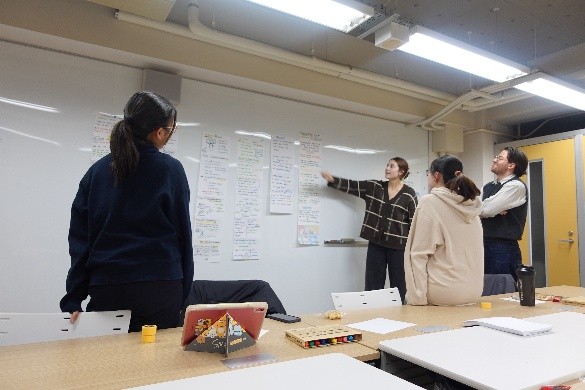
After the presentations, we discussed several intriguing points:
・Identity: It can be difficult to distinguish between our “true self” and the persona we adopt within a group.
・Complexity: Rather than being just one of the four types, human behavior is likely a complex blend of these patterns.
・Practicality: This classification serves as a valuable tool for effective communication.
・Synergy: While “Red” (results/speed-oriented) and “Blue” (process/accuracy-oriented) are opposites, working together could lead to great results.
・The “Green” Type: We speculated that “Green” people find happiness in the happiness of others, leading to a tendency for self-sacrifice—a trait that might be common among harmony-seeking Japanese people.
・Blind Spots: Since “Green” people deeply value being kind, they might sometimes fail to realize when they’ve made a mistake or struggle to understand why their actions were wrong.
The conversation became particularly lively when discussing the “Green” type. We shared personal experiences, such as a story about a dormitory filled with “Green” people who, due to their dislike of confrontation, ignored broken facilities and endured the inconvenience for a long time.
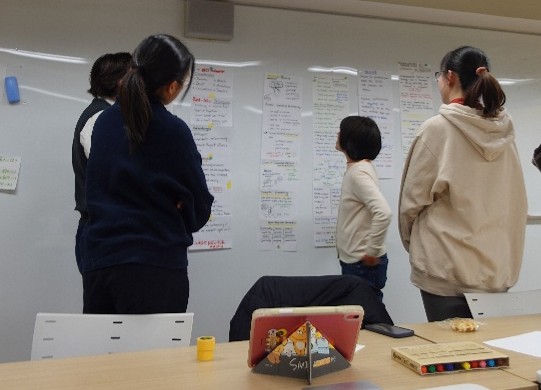
What we learned in this class
In this workshop, each participant read 10 pages of a book about communication styles and shared the content. Listening to the presentations was fascinating, as many of the examples resonated with my own experiences.
Through the discussions and personal episodes, I realized that these differences in communication styles are things we often encounter in school or daily life. I believe that these “color-coded” types shouldn’t be used to label people rigidly. Instead, by understanding them as general tendencies, we can make our communication much smoother and more effective.
Written by
Aoi Ishikawa, M2, School of Life Science and Technology, ToTAL 7th cohort