
| Facilitator | Tasuku Watanabe (ToTAL Student) |
| Date & Time | Friday, November 21, 2025, 18:00 – 20:30 |
| Venue | Room S6-305, South Building 6, Ookayama Campus |
| Book | Can We Not Escape Our Biases? (Toshiaki Suzuki) |
Objectives
・To practice summarizing and sharing complex themes in a short timeframe.
・To gain experience in accepting others’ perspectives and deepening dialogue.
・To improve language proficiency and expressive skills.
Overview
In this workshop, we will conduct a study group to explore books that (1) aid in leadership development and (2) enhance insight into future society. We will utilize a unique reading method called “Active Book Dialogue” to facilitate concentrated reading and discussion among participants within a limited time.
Why did we choose this book?
Many Japanese believe that most of us are “allergic” to debate. While it is true that there are fewer debate lovers here compared to Western countries, there are certainly Japanese people who are enthusiastic about it. This assumption is an example of “unconscious bias.” Through this book, we aim to share our experiences and expand our thinking about unconscious biases.
Activity 1: Read Book(Co-summarize)
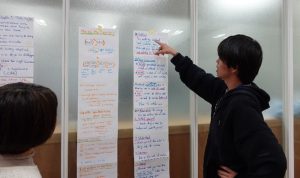
Each participant reads 10 to 15 pages and summarizes them on five sheets of B5 paper. Personally, I am not good at making short summaries, so it was a good exercise to improve that skill. Some finished the task quickly, while others took until the end of the limited time.
Activity 2: Presentation (Relay-presentation)
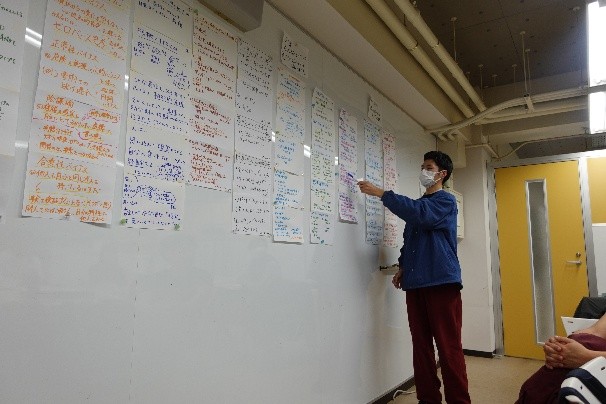
Each person pretends to be like the writer and makes presentations in 2 minutes using 5 paper slides. I saw some drawings in the slides and participants present in their own style. It seemed that 2 minutes were not enough for most people and it was good practice to present what you want to say simply.

Activity 3: Discussion, sharing own episodes
After the presentations, we discussed our impressions and daily experiences regarding “biases”—first in pairs, and then in groups of three. Everyone I spoke with had deep personal insights regarding assumptions and prejudices, making it very enjoyable to listen to. Since I rarely discuss such topics in daily conversation, this was a valuable opportunity to encounter diverse values and perspectives.
Personally, I was intrigued by opinions such as, “The author is trapped in the ‘bias’ that having biases is inherently bad,” and “We cannot escape the loop of assumptions.”
What we learned in this class
This “Book Dialogue” offers new perspectives and opportunities for reading, not only for those who are reluctant to read but also for regular readers. Furthermore, by sharing and deepening our thoughts with other participants, we can gain a multi-dimensional understanding of the book’s themes.
Although I am a regular reader, I rarely have the chance to summarize, present, or share what I have read with others. I believe that the act of explaining the content to others allowed me to understand it more deeply, even within the limited time. I realized once again that reading should not just be a solitary activity; there are profound insights that can only be gained through dialogue with peers.
Written by
Aoi Ishikawa, M2, School of Life Science and Technology, ToTAL 7th cohort