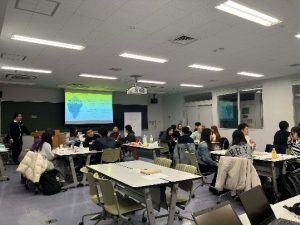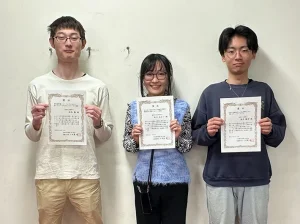

| Facilitator | Makiko Imai Certified NVC Trainer, Consultant/Coach/Facilitator/Writer, ORSCC Systemic Coaching certified Seiji Nagata Representative of Restorative Circles Japan, Conflict Resolution Facilitator, Graphic Harvester |
| Date & Time | Day 1: Friday, January 9, 2026, 17:00–20:00 Day 2: Friday, January 16, 2026, 17:00–20:00 |
| Venue | S6-203 (Day 1) and S6-308 (Day 2), Ookayama Campus |
Overview
In this workshop, we learned about “Nonviolent Communication (NVC),” a communication method to build better relationships with others. NVC aims to achieve mutual understanding by focusing on “feelings” and “needs”, rather than criticizing or blaming others when we face conflicts or misunderstandings. In daily life, we often unconsciously use language that contains evaluation, judgment, or criticism. However, such expressions can make dialogue and mutual understanding more difficult. In this workshop, we first learned about the basic concepts of NVC as an alternative approach. In particular, we gained a deeper understanding of the concepts considering the 4 key elements (Observation, Feeling, Needs, and Request) through both lectures and practical activities.
Day 1
Activity 1:Icebreaker
As an icebreaker activity, we first discussed topics such as “What does leadership mean to you?” and “Why is communication important for leadership?” in groups. After the discussion, each group shared their ideas with the class. Through this activity, participants became more comfortable talking with people.
Activity 2:Basic concepts of NVC
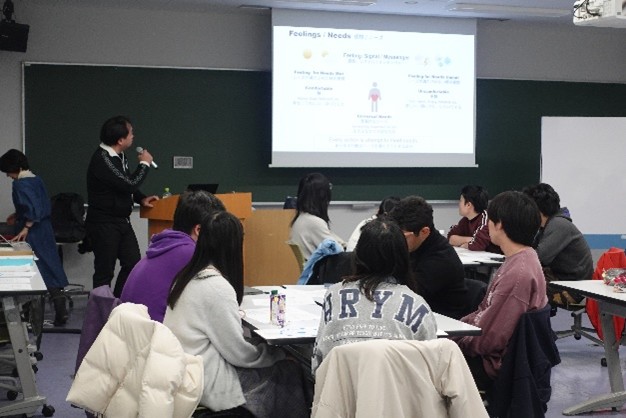
We learned about “violent communication,” which was introduced as a contrasting concept to NVC. In this lecture, we discussed how blaming others, making assumptions, and relying on stereotypes or fixed ideas can lead to difficulties in dialogue. Then, we learned the 4 key elements (Observation, Feeling, Needs, and Request). “Observation” means seeing situations objectively without evaluation or judgment. By considering this, we realized that it becomes possible to share situations without blaming others. Also, we learned that “feelings” should be distinguished from “thoughts”. In other words, once we think about an event, it is no longer a pure feeling. Furthermore, “needs” were explained as the values and meanings that people consider important. And “requests” should be expressed not as commands, but as proposals or gifts to others. By learning these concepts, we realized seeing all human actions as attempts to fulfill some kind of need is very important.
Activity 3:Self-empathy exercise
Next, we worked on self-empathy exercise that focused on our inner feelings and needs. In this activity, we reflected on events in daily life and tried to understand ourselves by talking about feelings and needs. For example, when we felt irritated with someone, we reflected on questions such as “What did the other person say to you?”, “What thoughts came to your mind?”, and “What feelings do you have now when you remember the experience?”. Through this process, we realized that needs such as “want to be understood” or “want to be respected” had not been satisfied. By focusing on the needs based on the facts, I felt that I was able to understand myself deeply.
Activity 4:Empathic listening
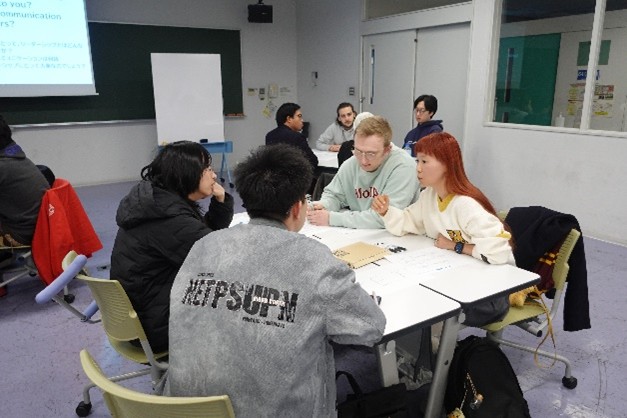
Next, we worked on empathic listening to understand the inner feelings and needs of others. In this activity, participants were asked to listen without their opinions or interpretations considering the feelings and needs behind the speaker’s story. In the pair work, one person was the speaker and the other was the listener. Rather than evaluating the speaker’s story, the listener focused on the speaker’s needs and responded that “Is ○○ important to you?”. Through this process, we realized the importance of trying to understand the needs behind words. We also experienced that by stopping interpreting the story or giving advice immediately, it became possible to create a space where the speaker could talk more openly and deeply. In addition, it was impressive to see that when feelings and needs were expressed in words, the speaker often felt truly understood and empathized with. Through this activity, I felt that empathic listening is fundamentally an attitude of being interested in the other person’s inner feelings, and that it is effective for building trustful relationships.
Activity 5:Dialogue using NVC
Finally, we practiced dialogue using the NVC elements that we had learned throughout the workshop. Specifically, we reflected on situations where conflict or disagreement occurred and communicated our thoughts to others by organizing them based on the four elements of NVC (Observation, Feeling, Needs, and Request). After that, the listener shared the points they considered important or meaningful in the presentation. Then, the speaker listened to this feedback and checked whether their intentions had been correctly understood. Through this activity, I felt that NVC promotes empathy and helps deepen mutual understanding.
Day 2
Activity 1:Reflection on the previous session
First, participants reflected on and shared what they had learned in the previous session in the group. We were reminded of the idea that “all human actions are attempts to fulfill certain needs”.
Activity 2:Lecture on requests
Next, we learned about the concept of “requests” in NVC and how they differ from “demands”. In the lecture, it was explained that request in NVC means being able to respect the other person even when they respond “no”. On the other hand, if a person blames the other person or becomes angry when their request is refused, then it is the demands. In this way, we learned that requests mean to respect the needs of both people, whereas demands mean to care only for their own needs.
Through this lecture, I also realized that in daily life, I may sometimes intend to make a request, but unconsciously make a demand instead. I learned that in NVC, it is important not only to express our own needs, but also to respect the other person’s freedom and choices. Furthermore, we learned that the goal of communication should not be to make others obey us, but to build connections by understanding each other’s needs.
Activity 3:Lecture on observation
Next, we learned about the difference between “observation” and “interpretation” in NVC. In NVC, it is important to describe situations based on facts, without including personal judgments or assumptions. On the other hand, expressions such as “You always criticize others” or “You are that kind of person” contain personal evaluations and interpretations. Through this lecture, I realized that we often speak with unconscious assumptions or judgments in daily life. Therefore, I felt that observing facts objectively leads to building mutual understanding.
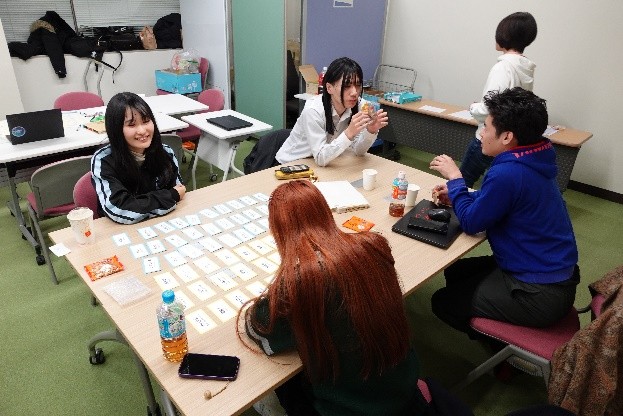
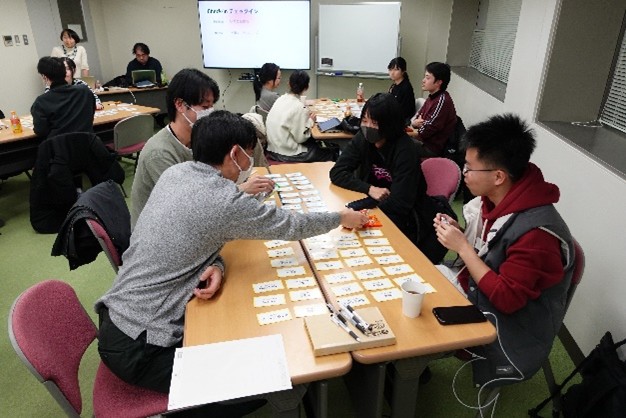
Activity 4:Empathic listening using cards
Next, we conducted empathic listening using cards that described different feelings and needs. The purpose of this activity was to understand the emotions and needs behind another person’s words in situations involving conflicts or dissatisfaction. During the activity, we also practiced distinguishing between “observation” and “interpretation.” For example, the statement “My sister said she could not go to the movie” was an observation, while “She is selfish” was an interpretation. In this way, I realized that separating facts from evaluations helps us focus on our feelings and needs instead of blaming others. We also practiced feedback focused on fulfilled needs. Specifically, we expressed our thoughts in the following way, “When you did ○○, I was happy because my need for ○○ was fulfilled. Thank you”. By doing this, I learned the importance of not only saying “thank you,” but also explaining and sharing specifically why I feel grateful. Through this activity, I realized that even in difficult situations, focusing on feelings and needs can lead to better mutual understanding. I also felt that empathic listening deepens understanding of others and myself.
Activity 5:Check-out
At the end of the workshop, participants shared what they had learned and what had left an impression on them throughout the two-day session. Then, they shared the contents of their discussion with the entire class. Many participants said that the idea “there must be some kind of need behind the behavior” was especially impressive. In addition, they said how difficult it is to separate “observation” from “interpretation”, and realized that they often unconsciously make judgments or assumptions during daily conversations.
Reflection
Through this workshop, my recognition of communication changed significantly. Until now, when problems occurred, I tended to focus on the words and actions. However, from the perspective of NVC, I learned that it is important to focus on the needs behind them. I also realized the difficulty and the importance of listening to others without judging or evaluating them. In the future, I would like to apply these ideas to daily communication in research and collaborative work by considering the needs of others.
Additional note
I was impressed that the participants seemed to enjoy sharing their experiences and emotions with others during this workshop. In particular, during the pair and group activities, participants showed a strong willingness to understand each other empathetically and I realized the importance of NVC. I strongly recommend this workshop to people who struggle with interpersonal communication or dialogue and who want to improve their communication skills.
Written by
Yuta Murao, D2, School of Life Science and Technology, ToTAL 6th cohort