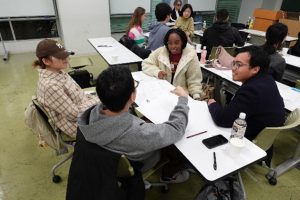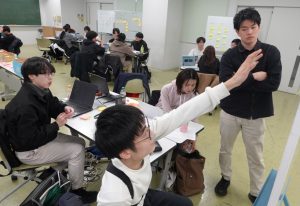

A workshop “Systems Thinking and Leadership,” part of the ToTAL course Fundamental Group Work for Leadership, was held on January 25 and February 8, 2026.
| Faciiltator | Mr. Akihiro Fukutani (About Mr. Fukutani: He worked in corporate planning at a Japanese startup and in the marketing department of a U.S. healthcare company. He then supported workshops by Peter Senge at Society for Organizational Learning (SoL) in the United States, and has been mentored by him for about 10 years. Since 2018, he has co-led the “Learning Schools” Lab, promoting systems thinking and the concept of learning organizations in the field of education. Currently, he serves as a systems thinking education advisor for the Kumahira Security Foundation and as a coordinator of SoL Japan, supporting the introduction of systems thinking for teachers and students at junior high schools, high schools, and universities.) |
| Date and Time | January 25 and February 8, 2026 (Sun) 10:00–16:00 |
| Location | S4-202, South Building 4, Ookayama Campus |
Overview
In this course, we learned about “systems thinking,” which helps us understand complex problems in a structured way, and “leadership,” which enables us to apply this thinking in practice. In our society, cause and effect are not always close to each other and actions often have impacts in distant places or in the future. Therefore, relying only on intuitive and short-term decision-making can fail to understand the true nature of problems and may lead to unexpected negative outcomes. For example, solutions to one problem can create new problems, and short-term improvements can lead to long-term decline. These situations occur frequently in society and business. Behind such phenomena, there are “systems” in which elements influence each other. Systems thinking is an approach that views these complex situations not as isolated events, but as interconnected events, allowing us to identify root causes and develop fundamental solutions.
In this course, we focused on complex features such as feedback loop structures behind surface-level events, and aimed to develop perspectives and methods to understand connections between events at a deeper level and create desirable outcomes. Specifically, through simulations like the Beer Game and problem analysis using causal loop diagrams, we learned how systems behave in a hands-on way and considered how individuals should make decisions. From a leadership perspective, we also learned the importance of not only addressing immediate problems, but also taking a broader view of the entire system and thinking about how to influence it to create sustainable positive change.
Activity 1:Beer Game (Day 1)
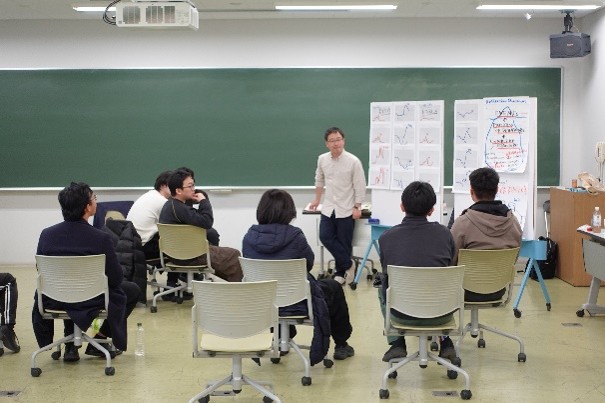
On the first day, we conducted the Beer Game, which simulates a supply chain. Participants took roles such as retailer, wholesaler, distributor, and manufacturer, and made decisions about inventory and ordering. Since each person had limited information, it was difficult to understand the overall situation and make appropriate decisions.
Activity 2:Reflection on the Beer Game and Lecture (Day 1)
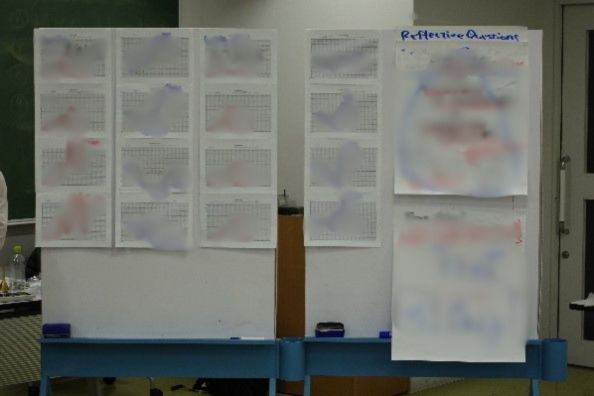
After the game, we reviewed the results of each team and observed the “bullwhip effect” in both teams, where excess and shortage of inventory occurred repeatedly in cycles. This showed that individual decisions can lead to inefficient outcomes for the system as a whole. In fact, many participants said it was difficult to make decisions because they could not communicate with others in different roles and could not see what was happening in the whole system. In the lecture, the instructor explained the system characteristics behind this phenomenon. One important point was that the problem was not caused by individual mistakes, but by the structure of the system itself. This helped us understand the importance of focusing not only on individuals but on the entire system when solving problems. The lecture also introduced the idea that systems thinking is part of the concept of a “learning organization.” A learning organization consists of three pillars and five key disciplines. In this workshop, we mainly focused on “systems thinking,” but also learned about “mental models.” Using the “iceberg model,” we saw that behind visible events, there are patterns of behavior, underlying structures, and people’s assumptions or beliefs (mental models). This helped us understand the importance of looking beyond what we can easily see and focusing on the deeper structure behind it.
Activity 3:Introduction to Causal Loop Diagrams (Day 2)
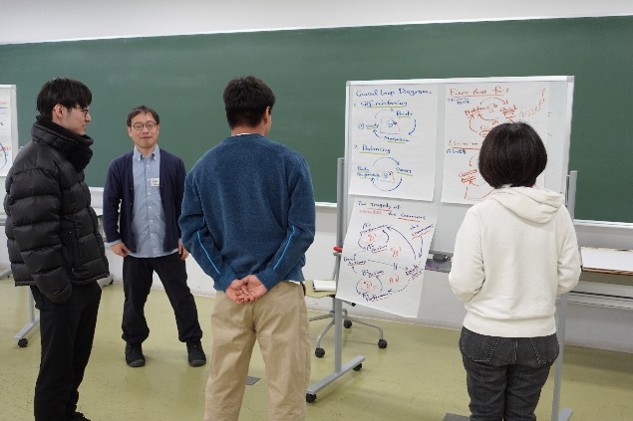
On the second day, we learned about “causal loop diagrams,” a tool used to visualize the structure of systems. These diagrams show the relationships between elements in a system by connecting them with arrows, and they are very useful for understanding complex phenomena. There are mainly two types of loops: “reinforcing loops (R)” and “balancing loops (B).” Reinforcing loops amplify changes. For example, an increase in sales leads to more investment, which then leads to further increases in sales (a positive or negative cycle). In contrast, balancing loops work to stabilize the system by reducing changes. For example, an increase in inventory leads to a decrease in orders, which then reduces inventory (moving toward balance). In this way, causal loop diagrams are not just a collection of elements, but a way to understand systems as connected structures. They are useful tools to find the root causes of problems.
Activity 4:Creating Causal Loop Diagrams (Group Work) (Day 2)
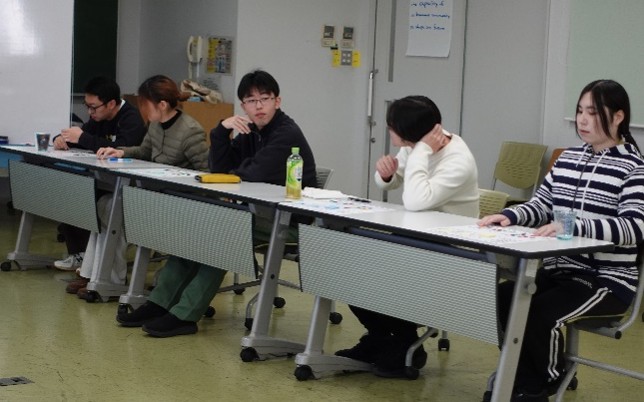
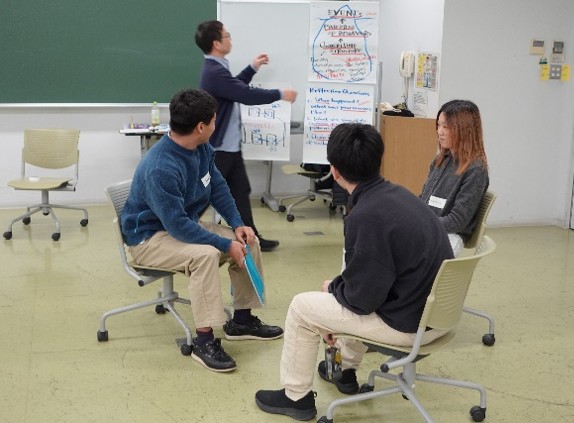
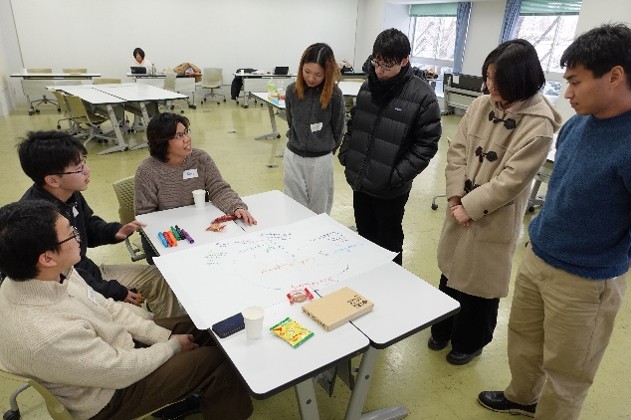
After the lecture, each group selected a specific social issue as a theme and created a causal loop diagram. Using examples such as the Beer Game and everyday problems, we discussed which variables were involved and how they influenced each other, and organized them into a structured diagram. During this process, it was interesting to see that the same phenomenon could be represented in different ways, depending on which elements we chose as variables and which causal relationships we focused on. In addition, since group members had different ways of thinking and perspectives, discussing and integrating these ideas led to a broader understanding.
Activity 5:Presentation, Reflection, and Vision Work (Day 2)
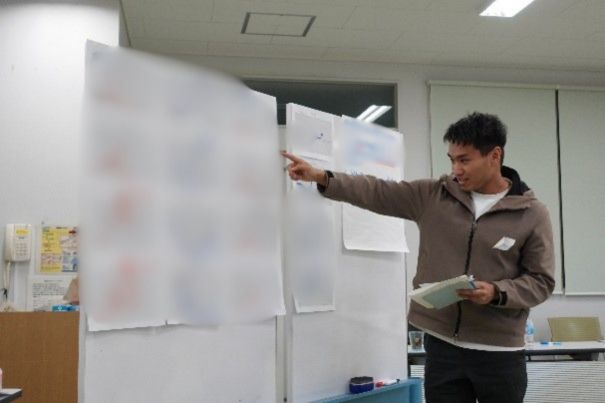
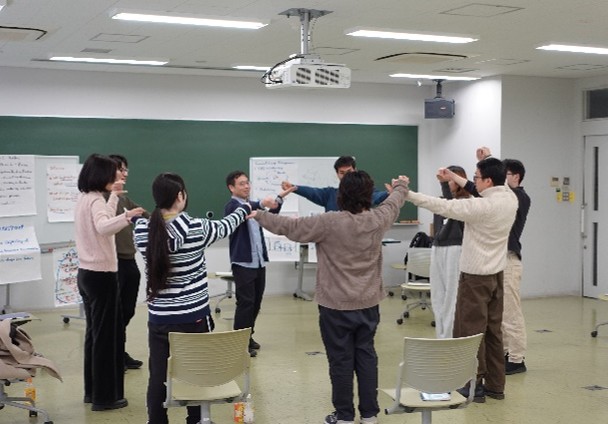
Each group presented their causal loop diagrams and discussed them with all participants. By listening to other groups, we learned new perspectives and ways of understanding the structure we had not noticed before. At the end, we reflected on the workshop and shared the importance of systems thinking in understanding complex problems structurally. In particular, we deepened our understanding that identifying the underlying structure behind visible events leads to more effective problem solving. As the final activity, we experienced “vision work.” Participants closed their eyes for about 3 minutes and imagined in detail the future or state they truly want to achieve. This activity is related to “shared vision,” one of the key elements of a learning organization, and provided a valuable opportunity to reflect on us and clarify our future direction. By combining this with systems thinking, I felt that by reflecting on my own values and goals, I could make more proactive and intentional decisions.
Reflection
Through this workshop, I strongly realized the importance of systems thinking. In the Beer Game, I believed I was making reasonable decisions, but the results were far from ideal. This experience taught me that problems should be understood not only at the individual level, but also at the system level. I also found causal loop diagrams very useful for organizing complex situations. They helped me think beyond short-term solutions and focus on fundamental causes. From a leadership perspective, I learned that it is important to see the whole system and identify effective points for intervention. In the future, I would like to make decisions in my research and team projects with systems thinking in mind. In my research, I think this approach will help me understand results as interactions among multiple factors, rather than as a single cause. In team projects, systems thinking can also improve collaboration by viewing each role as part of a larger system.
Additional Note
I participated as both an observer and a participant. After struggling in the Beer Game, many participants seemed to understand the concepts better through the lecture. During breaks, participants actively asked questions and showed strong interest in systems thinking and causal loop diagrams. I highly recommend this workshop to those who want to understand complex problems, find effective solutions, and improve decision-making in research or team projects.
Written by:
Yuta Murao, D2, School of Life Science and Technology, ToTAL 6th cohort