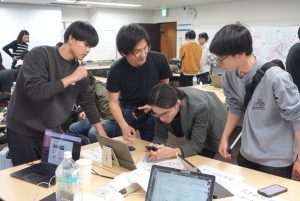

| Facilitator | Aoi Ishikawa, D1, School of Life Science and Technology, ToTAL 7th cohort |
| Date & Time | July 22, 2026, 18:00–20:00 |
| Venue | J3-309B, Yokohama Campus |
Objective
To overcome hesitations around public speaking and practically acquire discussion skills, including logical thinking and persuasiveness.
Overview
This workshop is a student-proposed, student-led peer-teaching initiative under ToTAL, with faculty providing operational support as needed. Through mini-lectures and topic-based games, students learn how to structure persuasive arguments. The first mandatory session covers the benefits of these skills, course navigation, and an icebreaker. The subsequent three optional sessions aim to equip participants to logically and effectively communicate their perspectives in discussions.
Activity 1: Introduction and Icebreaker
We began with self-introductions and an icebreaker. For the icebreaker, we conducted “GOOD & NEW,” where participants share something positive or novel from the past 24 hours. Most participants were same as the previous session, allowing the workshop to proceed in a consistently relaxed and open atmosphere.
Activity 2: Lecture & Practice Problems
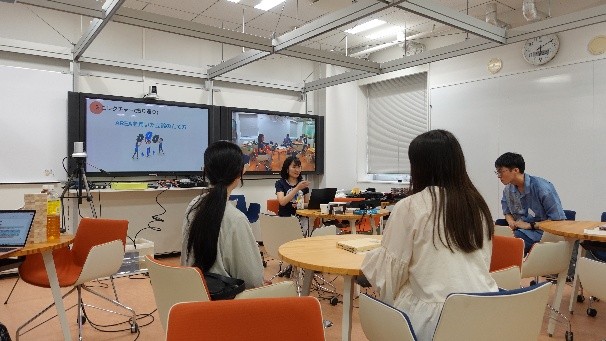
We conducted a review of the previous session followed by a lecture on this session’s core theme.
- Review of Previous Session: We revisited argument construction using the AREA framework, “NLC (Numbering, Labeling, Contents)” for clearly outlining the structure and main points, and “True × Important” for examining credibility and significance. Additionally, we adopted an output-oriented format by presenting flawed examples and asking participants why they were problematic via a quiz. They quickly raised accurate observations, demonstrating solid retention of the previous material.
- This Session’s Lecture (Toulmin Model): We delivered a lecture on the Toulmin Model. Since beginners often confuse “Warrant” with “Backing,” we highlighted their critical differences specifically, whether the element directly connects data to the claim. As a result, participants achieved high accuracy on the subsequent practice problems.
Activity 3: Debate Jenga (Ritsuron Jenga)
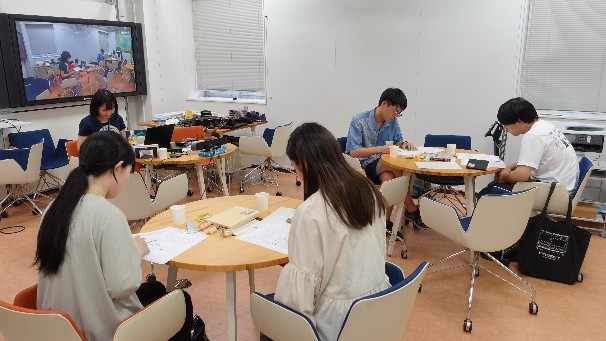
We conducted “Debate Jenga,” an exercise applying the newly learned Toulmin Model along with AREA and NLC. We allocated more time than last session to allow participants to search for data and supporting references. Due to the number of participants, TAs evaluated and judged the affirmative and negative teams. Both teams structured their arguments around NLC and AREA, making their line of reasoning remarkably clear. Furthermore, they introduced perspectives, reasons, and evidence that went beyond our initial expectations when designing the prompt. For instance, on the topic “Should paper textbooks be completely eliminated in elementary and junior high schools in favor of a full transition to digital tablets?”, in addition to anticipated points on learning efficiency and financial costs, participants highlighted the physical health impact caused by heavy school bags.
Reflections
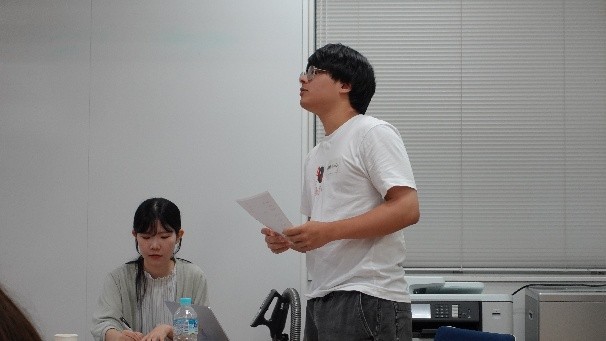
Given that debate is not popular in Japan compared to Western countries, “Tsutaeru Lounge” was designed to lower the barrier to entry and adapt the format for Japanese participants. Compared to conventional debate clubs with many international students where exchanges are rapid, the total volume of speaking might appear more reserved. However, because the emphasis is placed on structuring arguments and substantive reasoning, the claims presented were exceptionally logical and coherent. While debate clubs often emphasize rhetorical momentum and performance, Tsutaeru Lounge dedicates time to carefully building argument structures, demonstrating the distinct value and merits of each approach.
Written by
Aoi Ishikawa, D1, School of Life Science and Technology, ToTAL 7th cohort